How to measure a replacement shutter louver
Measure the louver body, compare the profile and identify the connection before ordering a custom-cut plantation shutter replacement.
A replacement louver needs to match the part already in your shutter. Record its body length, face width, thickness, material and connection style before choosing a replacement. In the UK and Australia, the same part is often called a louvre.
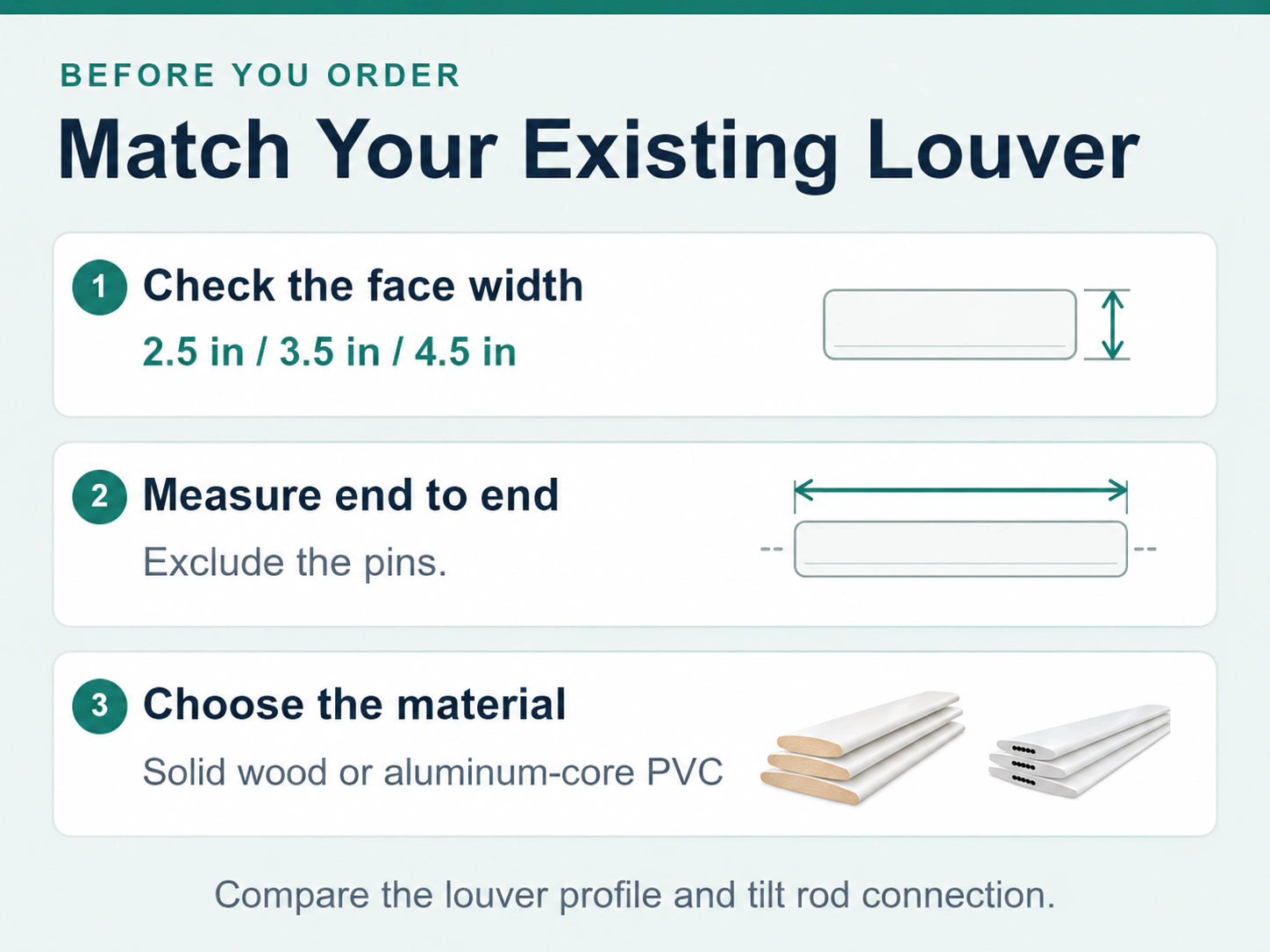
1. Choose an original part to measure
Use an intact louver from the same panel if the damaged one is split, bent or missing a section. Check that the reference louver has the same profile and connection. Take clear photographs of its face, both ends and the point where it connects to the tilt mechanism.
A ruler or tape measure helps with length and width. A caliper is useful for comparing thickness. Keep the measuring tool straight, read from its true zero point and record the unit beside every number. Measure each required replacement separately when the shutters have different panel sizes.
2. Record the finished body length
Measure from one end of the louver body to the other, excluding all protruding pins. Our offered body-length range is 1–38 inches (25.4–965.2 mm). This is the finished length to confirm for cutting.
Check the measurement a second time. If you work in inches, keep the original fraction or decimal when you write it down. If you convert to millimeters, use 25.4 mm per inch and avoid rounding away a meaningful difference. For several pieces, prepare a separate line for every length and quantity.
3. Compare face width and thickness
Face width is measured across the broad face of the louver, perpendicular to its length. Thickness is a separate measurement across the profile. These are the offered dimensions:
| Face width | Solid wood thickness | Aluminum-core PVC thickness |
|---|---|---|
| 2.5 in / 63.5 mm | 11.2 mm | 11.2 mm |
| 3.5 in / 88.9 mm | 11.2 mm | 11.2 mm |
| 4.5 in / 114.3 mm | 11.68 mm | 11.7 mm |
Compare the end shape as well as the numbers. A similar face width does not establish that the thickness, profile or pin arrangement will fit your shutter.
4. Identify material and connections
Choose solid wood or aluminum-core PVC to match the intended repair. Check the end pin holes and whether your shutter uses a front tilt rod, a hidden rear rod or a gear system. The offered holes, notches and gear slots have fixed sizes and positions; they are not individually adjustable custom machining.
Use the connection guide if the mechanism is unclear. Compare the actual preparation shown on the product listing with your original part before ordering.
5. Confirm the finish and order details
Existing shutters can change color with age, light and cleaning. Screen images also vary, so an exact match to an older finish cannot be guaranteed. Confirm the offered color along with material, width, thickness, exact body length, preparation, connection kit and quantity.
We supply replacement parts for your existing shutter. Complete panels and on-site installation are not included. Enter and confirm your specifications through the selected product listing before cutting.